Work Packages in OdinsAEye
The OdinsAEye project combines the expertise of scientists and specialists in diverse fields. The knowledge covered in the project is provided by experts on precision agriculture, crop health, machine learning experts, and others. To facilitate the run of OdinsAEye, the project was divided into the following 7 different work packages:
Work Package 1: Project Management & Dissemination
This work package ensures effective coordination, communication, and visibility across all project phases. Tasks involve centralised project administration to maintain a clear overview of deliverables, milestones, and budget allocations; insurance of strong leadership to align interdisciplinary teams and ensure timely execution; Management of follow-up activities and performance reporting to meet funding requirements; execution of dissemination strategies through digital channels, publications, and presentations, and facilitation of knowledge-sharing via annual rotating workshops, regular meetings, and shared documentation. As a crucial step the industrial partners reach to an agreement on IP usage and rights.
WP lead: Aarhus University
Work Package 2: CropCareCam – Development, Testing & Automation of Image Acquisition
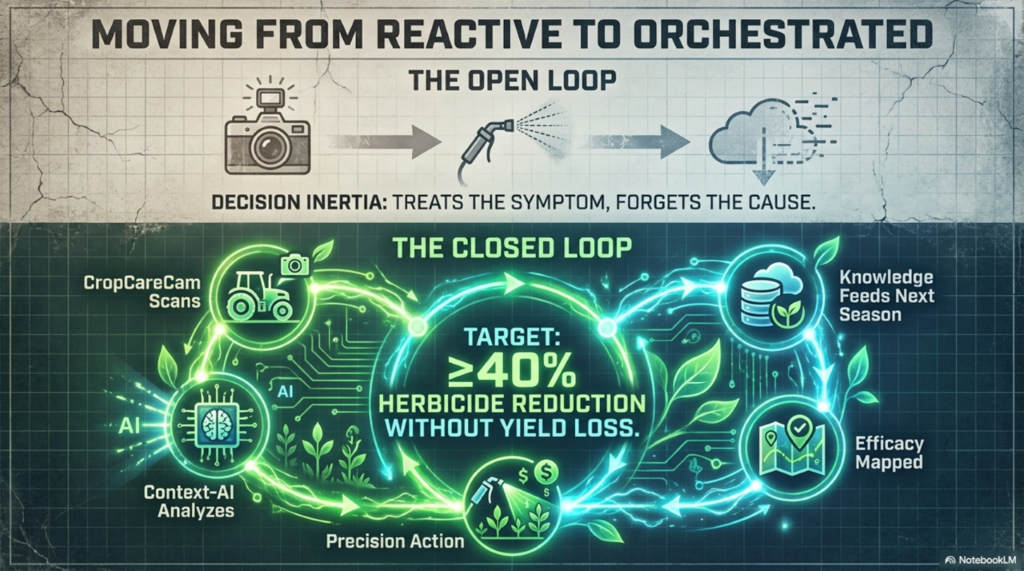
WP2 works on developing, refining, and automating the CropCareCam system based on the AGRO-Well prototype. As the project’s “digital eye,” it is designed for mounting on existing farm machinery (tractors, implements, or robots) and will refine the prototype hardware and achieve fully automatic high-resolution images (4-6 pixels/mm) capture and upload, which will then be validated in field operation on 2–3 farms during normal field operations, providing detailed information about the field and crop condition.
Tasks involve adapting hardware/software, ensuring robust image capture for real-time monitoring, and implementing reliable upload mechanisms to the analytics platform. Field trials across 2-3 farms will stress-test the system in diverse real-world conditions. Iterative testing ensures continuous performance enhancement in terms of system stability and data quality.
WP lead: AI Lab
Work Package 3: AI Analysis & Context-AI: Implementing Model Selection for Optimal AI
WP3 delivers the AI core that turns ultra-high-resolution crop/weed/insect images into DSS-ready, species-level intelligence to cut herbicide load now and build the basis for future insecticide reduction. An agentic Context-AI selects models by crop, growth stage and conditions, translates hierarchical detections into DSS inputs (e.g., CropProtection Online), and learns from field outcomes. Targets: ≥90% classification across crops/stages and robust real-time use while piggy-backing on routine operations.
Agentic modules: (i) Reasoning + Agronomic Knowledge Base; (ii) Planning/Tool-use for detection→DSS query→recommendation; (iii) CPO API wrapper; (iv) Memory for adaptive learning; (v) Human-in-the-loop for ambiguous cases. Task 3.6 closes the loop to deliver DSS-ready, optimised herbicide recommendations directly from OdinsAEye detections.
WP lead: Aarhus University (ECE)
Work Package 4: Platform API – Integration with PerPlant & CropManager
The key tasks for WP4 are firstly the FMIS Integration (Implement a fully functional data exchange API linking CropCareCam outputs with farm management systems (e.g., PerPlant, CropManager) for seamless data flow) and secondly, the User Interface (Develop a user-friendly interface to present OdinsAEye insights and evaluate its usability with farmers on two pilot farms).
Thereby, this WP develops the core API enabling seamless data exchange between OdinsAEye and third-party platforms. Tasks are divided into developing primary APIs for PerPlant, RoboWeedMaps integration, and APIs for specialised crops via AILab. WP4 also focuses on disseminating classification results through context-specific templates and validating real-time performance.
Work package lead: PerPlant
Work Package 5: Practical Testing – Farm-Level Evaluation & Dissemination
This WP anchors the project in practical agricultural environments. Tasks include on-farm/on-station trials, technology evaluation in real-world conditions, and guidelines for data interpretation in farming. A custom dissemination tool will be developed, supporting context-specific decision-making. Close collaboration with WP3 and WP4 ensures the user inter-face (UI) and API suit real user needs.
WP lead: AG Precision
Work Package 6: Biodiversity – Monitoring of Plant and Insect Populations
WP6 tracks biodiversity using AI-analyzed image data to monitor plant and insect functional groups. Tasks involve integrating APIs from IGIS, AILab, and PerPlant for automated data retrieval, continuous data extraction to AU-AGRO’s platforms, and definition and documentation of biodiversity impact. The aim is to quantify ecological benefits using advanced, scalable monitoring techniques. Thus the key Quantifiable Goal is the “Biodiversity Impact”: Which monitors weed and insect biodiversity on test fields and documents the effects of targeted management.
WP lead: AU-AGRO
Work Package 7: Economics & Eco-Effect – Evaluation of Economic and Environmental Impacts
WP7 evaluates how the project impacts farm economics and environmental performance. Analyses include pesticide use, operational costs, and API-based metric extraction. Further tasks assess the alignment with sustainability goals and document tangible improvements. This WP closes the loop between technical innovation and measurable impact. Important to highlight here are the key tasks of 1. Knowledge-based Recommendations: Fine-tune an Agentic AI on CropProtection Online to provide context-specific pest/weed management advice, validated in field trials; and 2. Impact Evaluation: Assess economic and environmental outcomes, including quantified pesticide use reduction and changes in farm profitability.
WP lead: AU-AGRO